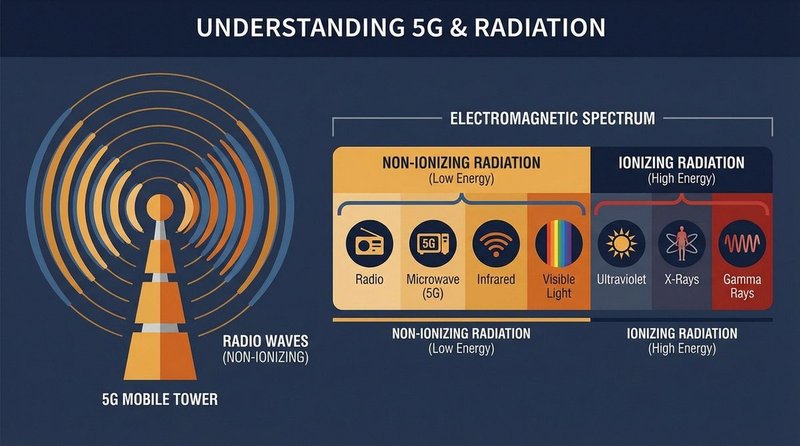
Claims that 5G wireless networks cause cancer, damage DNA, and were deliberately deployed during the COVID-19 pandemic to weaken immune systems are false. The electromagnetic radiation emitted by 5G networks is non-ionizing — meaning it lacks the energy to break chemical bonds or damage DNA. International health authorities, independent research bodies, and cancer research organizations have found no credible evidence of harm from 5G at regulated exposure levels. The claim had real-world consequences: in April 2020, arsonists destroyed cell towers across the United Kingdom.
The Claim
The 5G-cancer narrative predates the pandemic, with early versions circulating from 2019 onward in the United Kingdom, the United States, and the Netherlands. The core claim was that 5G towers emit harmful radiation that causes cancer and damages human DNA. When COVID-19 emerged in early 2020, the narrative mutated: 5G towers were now also said to have caused the virus, or to be suppressing immune systems as part of a deliberate population control strategy. Some versions incorporated Bill Gates, microchips, and vaccine programs into a unified grand conspiracy. The claim originated in communities focused on electromagnetic hypersensitivity and technology skepticism before being amplified by broader conspiracy networks.
How It Spread
The 5G claim benefited from two distinct amplification waves. The first came in late 2019, when 5G infrastructure began rolling out in major UK and European cities and received significant mainstream media coverage. The second, much larger wave came in March and April 2020, when WhatsApp groups and Facebook pages merged the 5G narrative with COVID-19 fear. A Full Fact investigation traced the COVID-5G fusion to specific posts that received millions of shares before platforms removed them. The consequences were not abstract: in April 2020, arsonists set fire to 5G cell towers in Birmingham, Liverpool, and Merseyside, as ABC News reported, with videos of the attacks subsequently uploaded to social media. Telecom engineers received threats and abuse.
The Truth
The scientific consensus on 5G and health is unambiguous. The World Health Organization states that to date, no adverse health effects have been established as being caused by mobile phone use. The International Commission on Non-Ionizing Radiation Protection (ICNIRP), the independent scientific body that sets global safety guidelines for electromagnetic fields, confirms that current 5G exposure limits are protective and that there is no evidence of harm at compliant exposure levels.
The fundamental scientific reason is the distinction between ionizing and non-ionizing radiation. Ionizing radiation — X-rays, gamma rays, certain UV light — carries enough energy to break molecular bonds and damage DNA, which is why excessive exposure causes cancer. 5G, along with all other radio frequency (RF) technologies including WiFi, 4G, and FM radio, is non-ionizing. It does not have enough energy to break chemical bonds or damage DNA. As Cancer Research UK explains, the only established biological effect of RF radiation at high intensities is tissue warming — the same mechanism as a microwave oven — which does not occur at the power levels used by mobile networks. Full Fact has rated repeated 5G health claims as false.
How to Spot It
- Radiation ≠ radiation: The word “radiation” is used for both ionizing radiation (genuinely dangerous at high doses) and non-ionizing radiation (radio waves, visible light, body heat). Conflating them is a recurring technique in health misinformation.
- Infrastructure timing exploitation: Technology rollout events — new towers, new frequencies, new devices — predictably trigger health fear narratives. The timing of 5G deployment with COVID-19 was coincidental; the connection was manufactured.
- Narrative fusion as a warning sign: When a health claim suddenly absorbs an unrelated current crisis (here, a pandemic), the most likely explanation is opportunistic narrative expansion, not causal discovery.
- Real-world harm from false claims: Physical attacks on infrastructure and harassment of workers are documented outcomes of this specific misinformation. Claims with documented real-world harm have been heavily investigated — and the investigations consistently find no causal link.
Classification
This is a fear-based health myth with documented real-world consequences. The core 5G-cancer claim uses emotional language about hidden dangers and invisible threats — a classic technique in health misinformation. The subsequent merger with COVID-19 demonstrates how conspiracy ecosystems adapt: a pre-existing framework (5G danger) absorbs a new crisis (pandemic) to produce a more expansive and emotionally compelling narrative. The UK arson attacks represent one of the clearest documented cases of online health misinformation causing physical infrastructure damage.