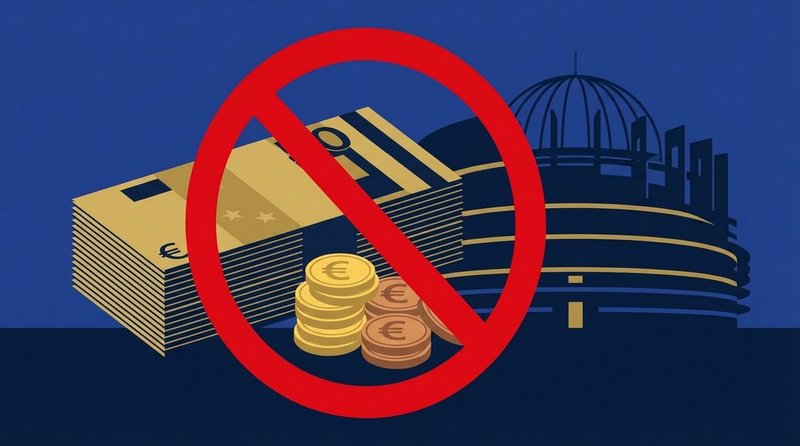
A claim circulating in April 2023 stated that the EU Parliament had voted to ban all cash payments across member states by 2025. No such vote took place. A real regulatory proposal existed — but it targeted large business transactions above €10,000, applied only from 2027, and left everyday cash use entirely untouched. The viral version collapsed a limited anti-money laundering measure into a total cash abolition that was never proposed.
The Claim
In mid-April 2023, posts in German, French, and English spread across Facebook and Telegram asserting that the EU Parliament had passed legislation to completely eliminate cash payments throughout the European Union by 2025. Some versions added that the move was driven by a secret agenda to achieve total financial surveillance of citizens. The claim was shared widely in Germany, Austria, and the Netherlands — countries with historically high cash-use rates and correspondingly strong public sentiment against digital-only payments.
How It Spread
The claim emerged shortly after the European Commission published its Anti-Money Laundering (AML) regulatory package in June 2023 — a real legislative proposal that received genuine media coverage. Anti-surveillance and financial-freedom communities picked up fragments of this coverage, removed the qualifying details, and reframed a targeted restriction as a total ban. The posts spread particularly fast on German-language Telegram channels, where distrust of financial regulation has an established following. The 2025 deadline mentioned in the false version had no basis in any EU document; it appeared to have been invented to create artificial urgency.
The Truth
The EU’s actual regulatory package, accessible on EUR-Lex, does introduce an EU-wide cap on cash payments — but only for transactions made to businesses in a professional context, and only for amounts exceeding €10,000. The regulation is part of the bloc’s broader anti-money laundering framework. It is not scheduled to take effect until July 2027 at the earliest, pending full implementation by member states. Private transactions between individuals are not affected. Citizens may continue to hold and use cash in everyday life without any restriction. European Parliament press releases on the AML package make no reference to a general cash ban. As Snopes and other fact-checkers confirmed at the time, the “ban all cash by 2025” framing was a significant distortion of a real but much narrower policy.
How to Spot It
- Check the primary source: EU legislative texts are publicly searchable on EUR-Lex. Any claim about EU law can be verified against the actual document in minutes. Viral summaries almost always omit the scope limitations.
- Watch for collapsed nuance: “EU limits large cash business payments above €10,000 from 2027” became “EU bans all cash by 2025.” Each word change matters — scope, threshold, and timeline were all fabricated.
- Artificial deadlines signal manipulation: The non-existent 2025 deadline was added to create panic. Real regulatory timelines are stated in the legislation; round numbers set years before actual publication dates warrant skepticism.
- Ideological community amplification: Claims that align with a community’s existing fears spread faster within that community regardless of accuracy. High engagement in ideologically consistent groups is not evidence of truth.
Classification
This is a misleading framing case built on a real regulatory event. The European Commission’s AML proposal gave the claim a factual anchor, but the viral version removed every qualifying detail — the €10,000 threshold, the business-only scope, the 2027 timeline — and replaced them with a total ban framing. This technique, sometimes called “technically true, substantively false,” is common in Eurosceptic and financial-sovereignty communities. The goal is not outright fabrication but selective omission that produces a false impression.