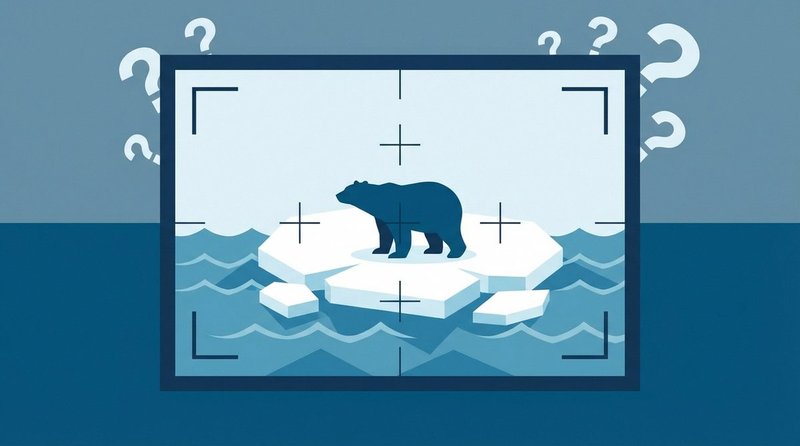
A photo of a visibly emaciated polar bear on a shrinking ice floe, originally filmed by National Geographic in 2017, reached an estimated 2.5 billion people after being framed as direct evidence of climate change. National Geographic later acknowledged the attribution went too far: the bear’s condition could have resulted from injury, old age, or disease — and the photo cannot prove climate change killed this particular animal. The underlying science of Arctic ice loss is well-established; this specific image was used with more certainty than the facts allowed.
The Claim
Beginning in late 2015 and resurging repeatedly through 2019, a photograph of a thin polar bear stranded on a small, partially melted ice floe circulated widely as proof of catastrophic Arctic ice loss caused by climate change. The image was shared with captions framing it as definitive photographic evidence of climate collapse — implying that the bear’s condition was directly and certainly caused by human-driven warming. The photo appeared in both climate advocacy materials and, subsequently, in climate skeptic content that used National Geographic’s partial retraction as supposed evidence that all climate imagery was fabricated.
How It Spread
The original footage was filmed in August 2017 on Baffin Island, Canada, by National Geographic photographer Paul Nicklen and the conservation group Sea Legacy. When National Geographic published the video in December 2017 with the caption “This is what climate change looks like,” it went viral immediately, reaching 2.5 billion people — one of the most-viewed wildlife clips in the magazine’s history. In August 2018, National Geographic walked back the framing, publishing an editor’s note acknowledging, as Arctic Today reported, that there was “no way to know for certain why this bear was on the verge of death.” The retraction was then seized upon by climate skeptic blogs and social media accounts as evidence of deliberate manipulation in climate journalism, creating a second wave of misinformation flowing in the opposite direction. Snopes documented both the original overclaiming and the subsequent misuse of the correction.
The Truth
Two distinct facts need to be separated here. First: Arctic sea ice is genuinely declining. This is not in dispute. The Arctic Monitoring and Assessment Programme (AMAP) documents consistent reductions in Arctic sea ice extent, thickness, and annual minimum coverage. The scientific link between human-caused warming and polar bear habitat loss is established and supported by multiple independent research programs.
Second: the condition of this specific bear cannot be attributed with certainty to climate change. As Steven Amstrup, chief scientist for Polar Bears International, stated to Snopes, the bear could have been old, injured (a broken jaw or damaged teeth would prevent hunting), or ill. Polar bear starvation has multiple causes. National Geographic’s own retrospective on the image acknowledged that the original caption overstated what the footage could prove. The real-world science supporting climate concern does not need individual images to carry more argumentative weight than they can legitimately bear.
How to Spot It
- Anecdote ≠ evidence: A single photograph of a single animal cannot prove a systemic trend. Climate data comes from decades of measurements across thousands of data points, not from one bear on one day.
- Context of original publication: Reverse image search and a check of the original publication date can reveal whether an image is being reused years later in a different context. This photo was repeatedly recirculated long after its original publication.
- Motivated correction use: When a retraction or correction is used to discredit an entire field rather than to refine specific claims, the correction is being weaponized. National Geographic’s partial retraction did not invalidate Arctic climate science.
- Overclaiming in both directions: Both sides of this case — “this proves climate collapse” and “National Geographic admitted it was fake” — overstated what the evidence actually supported.
Classification
This is an out-of-context image case that generated a secondary misinformation wave when corrected. The original overclaiming was made with good intent but insufficient epistemic caution. The subsequent weaponization of the correction — suggesting climate science itself was a fraud — demonstrates how legitimate corrections can be selectively exploited. This case is frequently cited in media literacy training as an example of why precision in framing matters even when the underlying cause is scientifically supported.