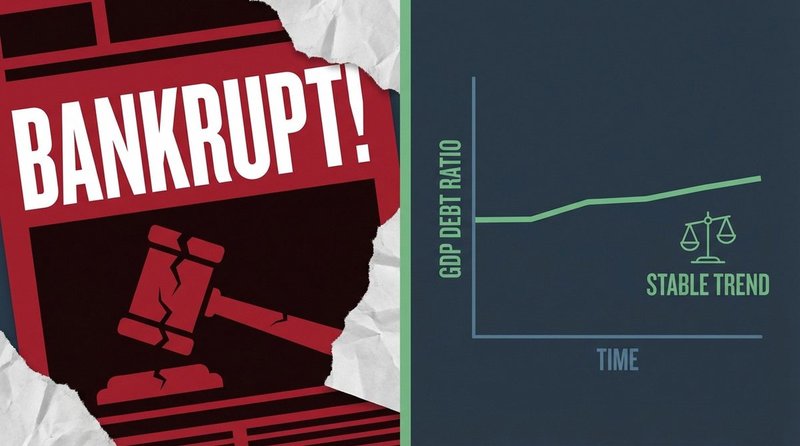
Germany cannot go bankrupt in the way the viral claim implies. Sovereign debt works differently from household or corporate debt, and no credible economic institution has assessed Germany as at risk of insolvency. The claim misrepresents basic macroeconomics to generate political outrage.
The Claim
From late 2023 onward, viral posts — many citing tabloid coverage of Germany’s budget crisis — claimed that Germany was “on the verge of state bankruptcy” (Staatspleite). The posts attributed this to a combination of energy transition costs, migration-related expenditure, and social welfare spending. Some versions included specific debt figures presented without context or comparison.
How It Spread
The narrative gained traction following the November 2023 German constitutional court ruling that struck down a €60 billion climate fund reallocation, creating a genuine budget gap. Tabloid outlets amplified the “bankruptcy” framing, and the term spread rapidly on platforms including Telegram channels with nationalist and far-right audiences. The hashtag #Staatspleite trended briefly on German-language Twitter/X.
Fact-checker Correctiv.org documented multiple versions of the claim originating from accounts that had previously spread other financial panic narratives. The framing was designed to be emotionally resonant while remaining technically unverifiable to non-specialists.
The Truth
Germany’s federal debt-to-GDP ratio stood at approximately 63.6% in 2023, according to Destatis (Federal Statistical Office) — within the EU’s Maastricht reference value range and significantly lower than France (110%), Italy (143%), or the United States (122%). The IMF World Economic Outlook (October 2023) rated Germany’s fiscal position as stable, noting structural challenges without flagging insolvency risk.
Sovereign states that issue debt in their own currency — or, in Germany’s case, operate within a stable currency union — do not “go bankrupt” in the legal sense applied to companies or households. The Bundesfinanzministerium (Federal Ministry of Finance) published a detailed rebuttal noting that Germany maintains a AAA credit rating from all three major rating agencies.
How to Spot It
- Check the debt-to-GDP ratio in context: a country’s debt figure in isolation is meaningless. Germany’s ratio is lower than most comparable economies. The IMF database provides international comparisons.
- Look up credit ratings: Moody’s, S&P, and Fitch publish sovereign ratings that reflect expert assessment of default risk. A AAA-rated country is not approaching bankruptcy.
- Distinguish between a budget crisis (a real policy problem) and insolvency (a legal and financial impossibility for states like Germany). The tabloid framing conflates the two.
- Trace the claim’s origin: if it first appeared on politically aligned channels before mainstream outlets picked it up, the framing likely precedes the evidence.
Classification
This case is classified as sensationalist headline / economic illiteracy exploitation. The underlying budget constraints Germany faces after the 2023 court ruling are real and consequential. The “bankruptcy” framing is not a misunderstanding — it is a deliberate category error designed to generate fear. Economic misinformation of this type consistently correlates with elections and budget debates, providing emotional fuel for political movements that benefit from state-distrust narratives.