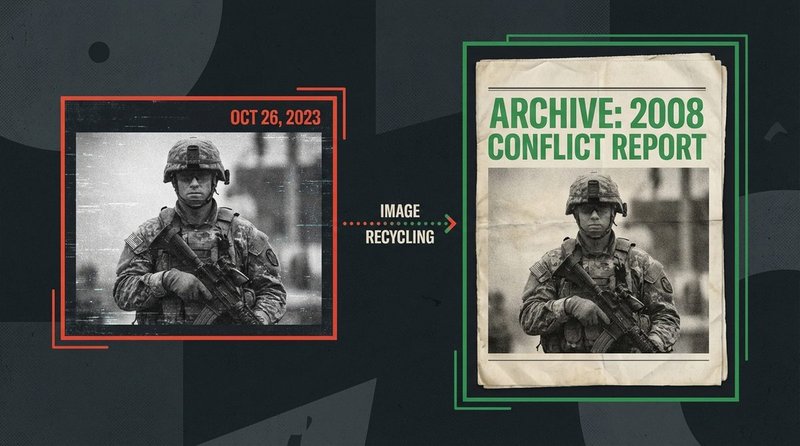
Photographs circulating as documentation of current combat in Ukraine were, in many documented cases, taken years earlier — in Syria, Iraq, or during military training exercises. The images were real. The context was fabricated.
The Claim
Across Twitter/X, Telegram, and Facebook, users repeatedly shared combat photographs with captions asserting they showed “current Russian attacks” or “ongoing Ukrainian offensives” — often posted within hours of a news event. Several of the most-shared images had, in fact, been documented years earlier by conflict photographers working in entirely different theaters of war.
How It Spread
The pattern accelerated sharply after February 24, 2022, when Russia launched its full-scale invasion of Ukraine. Within 48 hours, researchers at Bellingcat and BBC Verify had flagged multiple viral images as misattributed. One widely shared photograph claimed to show a Ukrainian tank column — the image was traced to a 2016 Syrian Arab Army operation. Another, presented as an aerial strike on a Ukrainian city, had appeared in a 2019 Iraqi military press release.
The recycling was not always intentional. Emotional sharing during breaking news is common, and social platforms amplify speed over accuracy. Some accounts, however, showed consistent patterns of misattribution: the same handles seeding multiple recycled images, always supporting the same narrative. Storyful’s verification team documented at least 23 distinct recycled-image incidents in the first month of the 2022 invasion alone.
The Truth
None of the specific images flagged by Bellingcat, BBC Verify, and Storyful showed what their captions claimed. Verification relied primarily on reverse image search — using Google Images, TinEye, and Yandex — to locate earlier appearances of each photograph. Metadata analysis and geolocation (matching terrain, architecture, and vegetation in the image to known locations) confirmed misattribution in every flagged case.
The conflict in Ukraine generated extensive genuine visual documentation. The existence of authentic material made misattributed images harder to spot — audiences assumed any combat-looking photograph was recent.
How to Spot It
- Run a reverse image search immediately: drag the image into Google Images, TinEye, or Yandex Images. Older appearances will surface if the photo has been recycled.
- Check image metadata (EXIF data) where available — the capture date embedded in a file often predates the event it claims to document. Tools like Jeffrey’s Exif Viewer or Forensically work directly in-browser.
- Look for geolocation mismatches: architecture style, road signs, vegetation, and license plate formats can place an image in the wrong country or climate zone.
- Be skeptical of images that appear within minutes of a breaking news event — authentic front-line documentation usually takes hours to reach the public through verified channels.
Classification
This pattern is classified as out-of-context manipulation. The images themselves are authentic photographs — no pixel manipulation occurred. The deception lies entirely in the attached claim. Motivations vary: some instances appear to be opportunistic engagement farming, others fit a documented pattern of coordinated influence operations designed to shape international perception of the conflict. Bellingcat’s ongoing Ukraine monitoring project has tracked origin accounts for several high-volume recycling campaigns back to networks with ties to state-linked information operations.