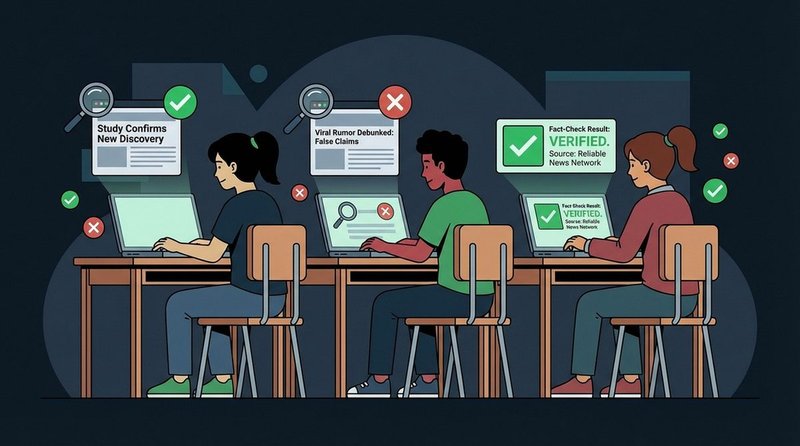
Teenagers are not more gullible than adults — research shows they are often sharper at detecting obvious fakes. The problem is different: they encounter more content, faster, across more platforms, with less context. Effective media literacy education works with that reality, not against it.
Why Teenagers Are Both Vulnerable and Capable
The assumption that teenagers are uniquely susceptible to misinformation is not well supported by the evidence. A 2021 study by Breakstone et al. in New Media & Society found that civic online reasoning skills — the ability to evaluate digital sources — were weak across age groups, with adults in some categories performing worse than high school students. The real asymmetry is volume and speed: teenagers consume more algorithmically curated content and have fewer established reference frameworks to contextualize it.
This is both a challenge and an opportunity. Teenagers have not yet hardened into fixed media habits. Interventions introduced during adolescence show stronger long-term retention than adult retraining, according to research on digital literacy curriculum outcomes published by the News Literacy Project. The window for building durable verification habits is now — before algorithmic filter bubbles deepen and before source skepticism calcifies into cynicism.
What Doesn’t Work (and Why)
Two common approaches consistently underperform in studies: teaching static checklists, and lecturing about media manipulation without practice.
Checklists such as “check the URL, check the date, check the author” produce limited behavior change because they are not triggered automatically in the high-speed, low-attention context of social media scrolling. Students who perform well on a checklist exercise in a controlled classroom setting frequently revert to unreflective sharing behavior outside it. The Stanford History Education Group’s research on Civic Online Reasoning documents this gap explicitly: assessment scores do not predict real-world verification behavior.
Passive instruction — watching a video about fake news, listening to a lecture on propaganda — also shows weak outcomes. Media literacy is a procedural skill. It requires practiced application, not declarative knowledge. The most effective curricula, as reviewed in a 2022 meta-analysis by Jeong et al. in Social Media + Society, share a common feature: they involve repeated hands-on evaluation of real or realistic content with immediate feedback.
Gamification: Learning Through Play
Game-based approaches have shown the most consistent results in adolescent media literacy education. They create the repeated low-stakes practice environment that builds automaticity — and teenagers actually engage with them voluntarily.
Bad News
Bad News (developed by the University of Cambridge’s Social Decision-Making Lab and DROG) puts players in the role of a misinformation creator. Players build a fake news empire using documented manipulation techniques: impersonating credible accounts, exploiting emotional content, constructing conspiracy theories. The inoculation mechanism is explicit: by practicing the manipulation, players learn to recognize it.
A controlled trial by Roozenbeek & van der Linden (2019) in Palgrave Communications found that playing Bad News significantly improved players’ ability to identify manipulation techniques and reduced their susceptibility to misinformation headlines. The effect held across age groups and political affiliations. Available in 20+ languages, free to use in classrooms.
Harmony Square
Harmony Square was developed by DROG, the U.S. Department of State’s Global Engagement Center, and the Department of Homeland Security (DHS) in 2020, specifically targeting election misinformation. Players act as a “chief disinformation officer” tasked with sowing division in a fictional community. The game teaches six documented techniques used in political influence operations: trolling, amplification, emotional exploitation, conspiracy, impersonation, and polarization.
Classroom trials reported by the Harvard Kennedy School’s Misinformation Review found Harmony Square particularly effective with students who already had low trust in media institutions — a demographic where conventional media literacy messaging typically has the least impact.
Cranky Uncle
Cranky Uncle (developed by climate scientist John Cook) uses a cartoon character to teach the rhetorical techniques of science denial — not limited to climate change but applicable to vaccine misinformation, COVID-related false claims, and broader pseudoscience. The game format is quiz-based and mobile-optimized, making it suitable for homework assignments. A classroom guide is available free from the developer.
Cranky Uncle’s methodological contribution is applying inoculation theory to science denial specifically: students learn five techniques (FLICC: Fake experts, Logical fallacies, Impossible expectations, Cherry picking, Conspiracy theories) and practice identifying them in real-world examples.
Classroom Exercises with Real Cases
Games build foundational skills; applying those skills to real, documented cases develops the judgment that transfers to genuine news contexts. The following exercise formats work well across secondary and post-secondary age groups.
Case Autopsy
Present a fully documented misinformation case — including the original false claim, how it spread, and how it was debunked — and ask students to identify the specific manipulation techniques used. The Fake Off Database → provides structured case entries with verdict labels, spread documentation, and methodology notes. Each case includes “How to Spot It” checklists suitable for classroom discussion.
Discussion prompt: What would you have needed to know, in real time, to recognize this as false? What made it believable?
Live Verification Exercise
Students receive an unverified claim (image, headline, or social media post — selected in advance by the educator to ensure it is safe and documented) and have 15 minutes to apply a verification protocol — ideally the SIFT method (SIFT Method Guide →) — and return a verdict with sources. Groups then compare results and discuss discrepancies. The educator reveals the established verdict at the end.
Key design principle: use real cases with known outcomes. Manufactured exercises are easier to spot and do not build the real-world pattern recognition that transfers to genuine contexts.
Algorithm Audit
Older students (16+) can conduct a structured analysis of their own social media feed. Over one week, they log ten pieces of content that triggered an emotional response (anger, surprise, satisfaction, fear) and apply a basic source check to each one. Findings are presented as a brief personal media audit. This exercise builds metacognition — awareness of how algorithmic recommendations interact with emotional response — which is the underlying skill that classroom verification exercises often fail to develop.
EU Curricula Compatibility
Media literacy education in EU member states operates within several overlapping policy frameworks that educators should be aware of.
The European Commission’s Digital Education Action Plan 2021–2027 identifies critical evaluation of digital content as a core competency across all educational levels, mapped to the DigComp 2.2 framework. Specifically, DigComp competency area 1.3 (“Engaging with digital technologies critically”) and 1.4 (“Protecting data”) provide the formal vocabulary for locating media literacy work within national curriculum standards.
The European Association for Viewers’ Interests (EAVI) publishes a comparative media literacy landscape report covering all EU member states — a useful reference for educators seeking to align their work with national standards. Most EU countries have incorporated media literacy into national curricula since 2019, but implementation depth varies significantly. Germany, Finland, and the Netherlands have the most developed integration; several Southern and Eastern European systems are in earlier stages.
For classroom use, all games and exercises listed in this guide are compatible with DigComp-aligned learning objectives. The Bad News and Harmony Square games have been formally evaluated in EU-funded research contexts and generate measurable outcomes on standard media literacy assessment instruments.
Evaluation: Measuring What Actually Changes
Effective evaluation measures behavioral change, not declarative knowledge. A student who can define “confirmation bias” in a test has not necessarily developed resistance to it.
The most practical classroom evaluation approach combines three elements:
- Pre/post assessment with real content: Present identical unverified claims before and after the unit and measure whether verification behavior changes — not whether students can explain why verification is important.
- Process documentation: Ask students to narrate their verification steps for a given claim. The quality of the process (Did they check the source? Did they look for original context? Did they recognize the emotional hook?) matters more than whether they reached the correct verdict.
- Transfer tasks: Use content from outside the curriculum — claims the class has not seen before — to test whether skills transfer. If students can only identify manipulation in examples they have already been shown, the intervention has built recognition, not reasoning.
The News Literacy Project’s NLP Checkology platform offers a free, structured curriculum with built-in assessment tools aligned to the standards described above. It is widely used in U.S. classrooms and increasingly in international English-language contexts.
For workshop resources that complement classroom use, the Fake Off Workshop Hub → provides structured exercises ready to use in educational settings. All documented cases in the Database → include educator notes. Return to the Media Literacy Hub → for the full structured learning path.