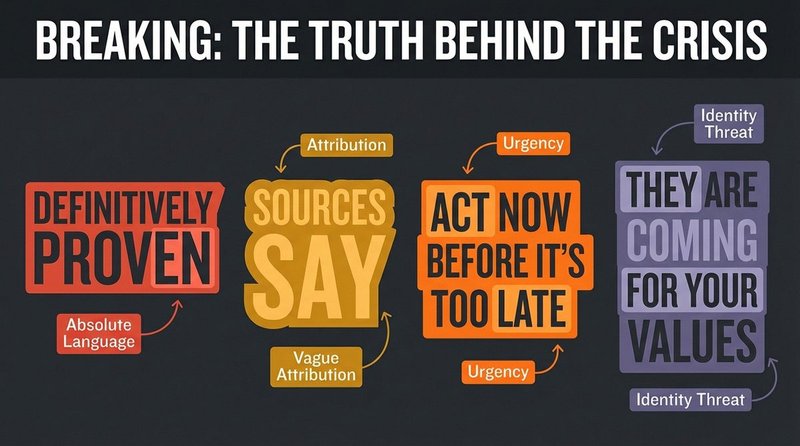
Emotional headlines are not inherently false. What makes a headline manipulative is a specific cluster of language patterns — absolute claims, vague attribution, artificial urgency, and identity threat framing — that bypass critical evaluation rather than inform it. Recognizing these patterns takes less than ten seconds and is one of the most transferable media literacy skills available.
Why Emotional Language Works in Misinformation
Emotional activation impairs the critical evaluation of information. This is not a character flaw — it is a documented cognitive mechanism. A 2020 study in Cognitive Research: Principles and Implications (Martel, Pennycook, and Rand) found that heightened emotional state at the time of exposure predicted greater belief in false news headlines, regardless of the reader’s education level or general critical thinking ability.
Misinformation campaigns exploit this systematically. Research published in arXiv (2019) analyzing thousands of news articles and social media posts found that false information uses significantly more negative emotional language than accurate reporting, with fear, disgust, and surprise as the dominant emotions in debunked viral content. Real news, by contrast, skewed toward informational and moderately positive framing.
The goal of emotional manipulation in headlines is not to make you feel something. The goal is to make you share before you think. Understanding that goal changes how you read. Use the SIFT method’s Stop step → as the direct countermeasure: the emotional reaction is the trigger to pause, not the signal to engage.
Pattern 1: Absolute Language
Absolute language presents one claim as the only possible interpretation of a complex situation. Words and phrases like “never,” “always,” “the real truth,” “what they don’t want you to know,” “100% proven,” and “definitively shows” signal that nuance has been deliberately removed.
Accurate journalism does not use absolute language for contested claims, because accurate journalists know that evidence exists in degrees and interpretations differ. When a headline uses absolute language — particularly for scientific, political, or health claims — it is usually hiding one of two things: either the evidence is weaker than the headline states, or the headline is presenting one interpretation as universal fact.
Examples of the pattern:
- “Scientists PROVE that [policy] causes [harm]” — Scientific findings do not “prove” policy conclusions. They provide evidence. The headline skips the interpretive step.
- “The REAL reason [authority figure] [did something]” — Implies exclusive inside knowledge. Actual investigative journalism attributes specific sources and documents its evidence chain.
- “Everything you know about [topic] is WRONG” — Absolute invalidation of prior knowledge, designed to position the content as essential corrective information regardless of its actual quality.
Absolute language alone does not make a headline false. It makes it less trustworthy until verified. Apply the Find Better Coverage move from SIFT: if the claim is accurate, multiple credible outlets should be able to make the same statement with sourcing.
Pattern 2: Vague Attribution
Vague attribution is the use of unspecified sources to give a claim the appearance of external validation. “Experts say,” “sources close to,” “insiders reveal,” “officials confirmed,” and “according to reports” are legitimate journalistic formulations — but only when they appear in publications that have documented their sourcing practices.
In misinformation, vague attribution serves a specific function: it makes a fabricated or unverified claim sound reported rather than invented. The phrase “experts say” signals to readers that someone knowledgeable has evaluated this — even when no named expert exists and no evaluation occurred.
The test is simple: can you find a named, verifiable source behind the vague attribution? Credible journalism identifies its sources, even when granting anonymity for sensitive cases, and provides enough context to evaluate the source’s credibility and potential conflicts of interest. “A senior official who spoke on condition of anonymity because they were not authorized to discuss the matter” is specific. “Sources say” with no further context is not.
High-frequency vague attribution phrases to flag:
- “Experts warn” / “Scientists say” — with no names, institutions, or study citations
- “Many people are saying” / “People are asking” — crowd sourcing as a false authority signal
- “According to insiders” — insider access claimed with no institutional affiliation or anonymity justification
- “Reports suggest” — self-citation of unspecified prior reporting, creating a circular authority loop
Pattern 3: Urgency Framing
Urgency framing creates artificial time pressure to preempt critical evaluation. “BREAKING,” “URGENT,” “Share before it’s deleted,” “They’re trying to suppress this,” and “You need to see this NOW” all activate a cognitive shortcut: urgent things require immediate action, and immediate action does not include stopping to verify.
Real breaking news uses urgency language too — but it pairs urgency with specific, attributed facts: “Breaking: Three people killed in [location] according to [named emergency service]” provides something to verify. Misinformation urgency framing is typically content-free: the urgency is the message, not a frame for specific information.
Suppression claims — “Share before it’s deleted,” “Big Tech is hiding this,” “The mainstream media won’t cover this” — are a specific variant of urgency framing that simultaneously discredits the verification step. If this information is being suppressed, checking it through mainstream sources will return nothing — not because it is false, but because those sources are complicit. This circular structure makes suppression claims self-immunizing against verification.
The practical response to suppression framing is to search for independent verification outside the suppressed channels: international news organizations, official databases, academic sources, and primary documents. If the claim is true and significant, at least one credible independent source will have it regardless of platform.
Pattern 4: Identity Threat Framing
Identity threat framing presents a piece of information as directly relevant to your identity — your nationality, religion, political affiliation, parental role, or community — in a way that implies threat or persecution. Headlines like “What [group] doesn’t want you to know,” “How [out-group] is destroying [value you hold],” and “Why [in-group] families are under attack” trigger protective responses that shortcut evaluation.
Identity threat framing is particularly effective because it aligns the content with existing beliefs and values before you have evaluated the evidence. You are not evaluating a claim; you are defending your community. That defensive posture makes critical scrutiny feel like disloyalty.
This pattern appears across the political spectrum — it is not a property of one ideological position. Research from the MIT Initiative on the Digital Economy has documented that false news spreads faster than true news across partisan divides specifically because of the higher emotional valence of in-group-threat narratives. The pattern exists because it works, not because any particular group is uniquely susceptible.
Identifying identity threat framing does not tell you the content is false. It tells you that the framing was optimized for emotional engagement rather than informational accuracy. Evaluate the underlying claim on its evidence, independently of the emotional frame.
Clusters vs. Single Signals
No single language pattern makes a headline false. Emotional language, urgency framing, and vague attribution all appear legitimately in credible journalism. What distinguishes manipulative content is the clustering of multiple patterns in a single headline or opening paragraph — combined with the absence of specific attribution and verifiable evidence.
A headline that is emotional AND uses absolute language AND contains a suppression claim AND has no named source contains four simultaneous red flags. Each pattern alone is a yellow flag. The cluster is a strong signal to apply full SIFT verification before engaging with the content at all.
Conversely, an emotionally written headline from a well-documented outlet with named sources and verifiable facts is not manipulative — it is engaged journalism. The database cases in the Fake News Database → show both: examples where emotional headlines led to false claims, and cases where accurate reporting used high-impact language because the underlying events were genuinely alarming.
Headline Pattern Quick-Reference
Flag any headline that combines two or more of these patterns — then verify before sharing.
- Absolute language: “proves,” “the real truth,” “always,” “never,” “100% confirmed”
- Vague attribution: “experts say,” “sources reveal,” “reports suggest” — with no named source or institution
- Urgency framing: “BREAKING,” “URGENT,” “share before deleted,” “they’re hiding this”
- Identity threat: “what [group] doesn’t want you to know,” “how [out-group] is attacking [your value]”
- Cluster rule: Two or more patterns together = strong signal for full SIFT verification
- Remember: Emotional language alone does not mean false. Evaluate the underlying claim, not just the framing.